ALOHA!
If you’re planning a trip to Oahu, plan your trip to avoid the jellyfish of Waikiki Beach!
There are many ocean dangers in Hawaii, and that includes the risk of dangerous marine life.
Among the dangerous marine life in Hawaii is jellyfish.
You can get stung by a jellyfish in Hawaii, and this includes Waikiki.
Jellyfish invasions are a thing on Oahu.
And Oahu’s biggest tourist spot of Waikiki Beach is one of the Oahu beaches that can have lots of jellyfish.

But the good news is, the jellyfish invasions aren’t random.
There is an increased risk of getting stung by a jellyfish if you go swimming in Waikiki during a certain time of month.
And so, if you have yet to decide your dates of travel to Honolulu, you might want to avoid the dates where Waikiki jellyfish invasions are predicted!
📌 Save this post for later! Save on Pinterest! 👈📌
How do you avoid jellyfish in Waikiki?
The best way to avoid getting a jellyfish sting in Waikiki is to not go swimming when there’s a bigger risk for a jellyfish invasion.
Yes, a jellyfish invasion is a thing in Waikiki!
There can be an influx of jellyfish seen in Waikiki on a monthly basis.
The timing of the visits of more jellyfish to Waikiki can generally be predicted.

There are so many jellyfish in Waikiki during a specific time of each month because of tides.
Scientists currently believe that the influx of jellyfish happens because when high tides happen at night, the jellyfish are able to cross over the coral reefs onto the beach side.
But when the tides get lower in the morning, the jellyfish essentially get trapped, unable to get to the other side of the coral reef out to sea because of the low water level.
This results in more jellyfish than usual on Waikiki Beach.
According to the Waikiki Aquarium:
The present theory is that when certain high tides occur at night, the jellyfish are carried over the reef and into the shallows along the beach.
When the tide flows out, the jellyfish are trapped and beach goers encounter them the next morning.
Researchers have found that in most cases, the jellyfish “invasions” occur eight to ten days after a full moon.
You can also watch the weather on local news, and if jellyfish might be a problem, you can expect that they will mention a box jellyfish advisory if there is one:
Waikiki jellyfish calendar
So is there a greater chance for jellyfish stings when YOU are in Waikiki?!
Good thing the Waikiki Aquarium has a convenient jellyfish calendar!

👆 Check the Waikiki jellyfish calendar to see when you might want to avoid going swimming at Waikiki Beach!
Because scientists believe that the jellyfish invasion has to do with tides, the jellyfish predictions are based on the timing of the full moon and tides.
The biggest risk for jellyfish stings in Waikiki is 8 to 12 days after a full moon.

So you can take a look at the Waikiki jellyfish calendar and find the month you’ll be in Waikiki to see if you’ll need to be extra worried about jellyfish stings!
This doesn’t mean that there will be no jellyfish outside of these times, but during this time period is when there’s a greater risk for tons of jellyfish.
🌴
Jellyfish warning sign

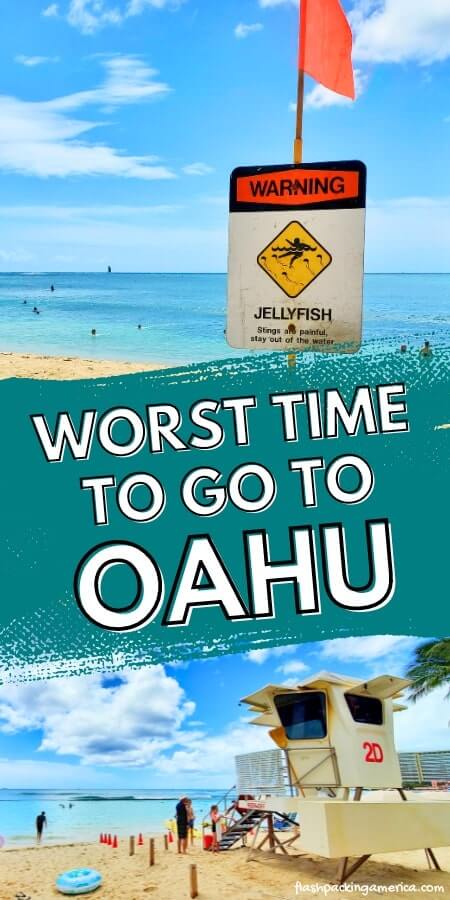
You can avoid jellyfish in Waikiki by not swimming when there’s a jellyfish warning sign.
If there is a bigger risk of getting a jellyfish sting, there will be signs up on Waikiki Beach… like during the predicted jellyfish invasions.
If you see a jellyfish warning sign on Waikiki Beach, it’s best to avoid swimming.

👆 Jellyfish warning sign at Waikiki Beach: Jellyfish stings are painful. Stay out of the water.
More of Hawaii marine life
If you’re interested in jellyfish in Waikiki, you may also be interested in this marine life in Hawaii:
- Waikiki snorkeling spots
- Where to see turtles in Waikiki
- Where to see turtles on the North Shore
- Hookipa Beach turtles in Maui
- Punaluu black sand beach turtles on the Big Island
- Hookipa Beach seals in Maui
- Shark attacks in Hawaii
If you’re going snorkeling in Waikiki, know before you go! Know what you’re seeing when you see it!
- humuhumunukunukuapua’a (Hawaii state fish… it’s not as hard to pronounce as you might think!)
- Hawaiian white-spotted toby (cute little Hawaiian pufferfish!)
Can you swim at Waikiki Beach if there’s a jellyfish warning sign?

👆 Should you go swimming if there is a jellyfish warning sign at Waikiki Beach in Hawaii?
Although the sign says to stay out of the water, in general, a jellyfish warning sign doesn’t necessarily mean that swimming is not allowed.
So you might see people swimming even if there is a stated bigger risk for jellyfish encounters.
If tons of people actually start to get stung by jellyfish, then that’s when Waikiki Beach might become completely closed to swimming.
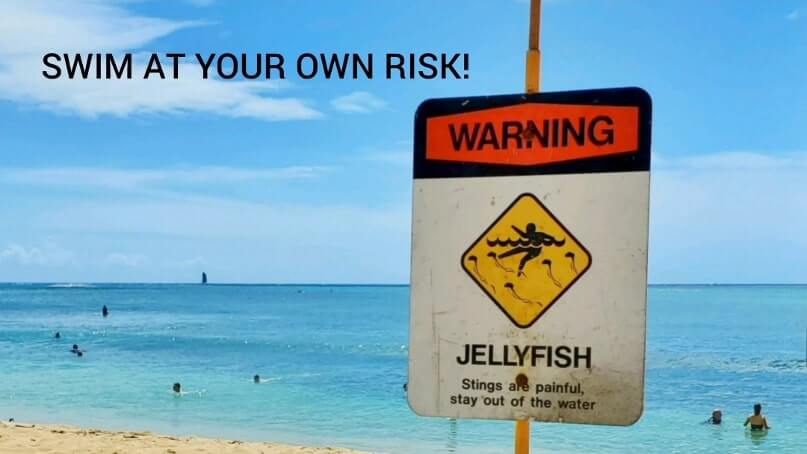
👆 Waikiki Beach is still open for swimming even if there’s a higher risk to get a jellyfish sting… unless a lot of people get stung by jellyfish! If a lot of people are getting jellyfish stings, they will close the beach.
Are there jellyfish in Hanauma Bay?
There can also be jellyfish invasions at Hanauma Bay, one of the top snorkeling spots on Oahu.
In March 2022, Hanauma Bay was closed due to lots of jellyfish. That was on March 27. The full moon was March 18, which means the Hanauma Bay jellyfish closure was 9 days after the full moon. So it lines up with the Waikiki jellyfish calendar too.

👆 The Waikiki jellyfish calendar can also be the Hanauma Bay jellyfish calendar. The day that Hanauma Bay closed due to a jellyfish invasion, there was a high probability for jellyfish on Waikiki Beach.
If you have flexibility, then you might want to avoid going to Hanauma Bay on the predicted jellyfish invasion dates.
Again, predicted jellyfish invasions don’t necessarily mean that the beach will close.
How to treat jellyfish stings
And if your stay in Waikiki will coincide with the potential for an increase of jellyfish on Waikiki Beach or Hanauma Bay, then you may also consider reading up on what to do if you or someone in your group experiences a jellyfish sting when swimming at Waikiki Beach.
- Here are tips from the University of Hawaii
- Here are tips from the Maui Ocean Center
In short, you want to treat jellyfish stings with vinegar, tweezers, and warmth… not cold!
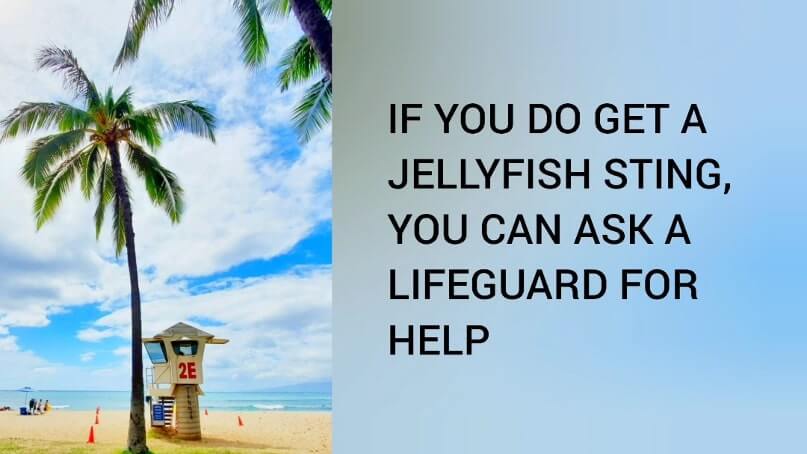
There are lifeguards across Waikiki Beach, and they can also help with jellyfish stings.
Hawaii jellyfish prep packing list
And so, if I wanted to be extra prepared in case I get stung by a jellyfish, then I would add to my Hawaii adventure packing list:
- vinegar in a small container
- tweezers
- hot hands warmers
I love hot hands warmers for camping in cooler temperatures and it seems like it could be useful as a travel option for jellyfish stings too…?! I have never actually packed anything extra specifically for jellyfish stings though. And again, I would expect a lifeguard would be able to help you out… if you’re at a beach with a lifeguard… and many beaches in Waikiki do have lifeguards during the day.
And that’s a bit about potential Waikiki jellyfish stings!
More for your trip to Waikiki and beyond:
- Things to do in Waikiki (for views!)
- Where to watch the Waikiki fireworks
- Free Waikiki hula show
- Banyan trees in Waikiki
- Best Oahu beaches
- Things to do in Oahu
HAPPY HOPEFULLY JELLYFISH STING-FREE TIME AT WAIKIKI BEACH!
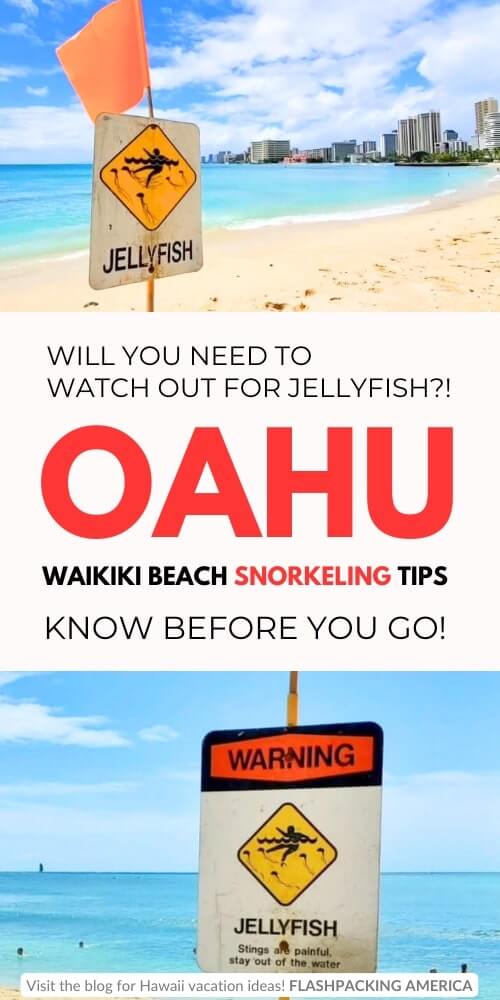
📌 Save this post for later! Save on Pinterest! 👈📌
There are partner websites included in this post. I may earn a commission.