
Hi there!
So you’re packing for snorkeling!


Or maybe you’ll just be swimming in the tropical waters without necessarily snorkeling, like swimming off the shores of the Hawaii, the Florida Keys, the Caribbean, or some other amazing tropical beach destination around the world!


Either way, you probably have SUNSCREEN on your list of what to pack for your beach vacation!
And, you may have heard of a more specific type of sunscreen… reef-safe sunscreen.
What does reef-safe sunscreen mean?!

So…
What IS reef-safe sunscreen?!
Why wear reef-safe sunscreen for snorkeling and swimming?
“Reef-safe” sunscreen refers to sunscreen that is safer for the coral reef of the ocean.
When you go into the ocean, whether that’s swimming, snorkeling, or really just standing around, the sunscreen you wear washes off into the ocean.
That means the chemicals from that sunscreen also go into the ocean.


And there are ocean scientists that say that those chemicals can make their way directly to the marine life of the ocean world.
And these ocean scientists also say that the effect of those sunscreen chemicals is BAD for the marine life, including coral reef.
Around coral reef is among the spots that turtles and colorful tropical fish look for their food.
The coral reef is what can make a place a top snorkeling destination!

There are affiliate links on this page. Among other partners, as an Amazon Associate, I may earn a commission from this.
Sunscreen for snorkeling and swimming: What makes sunscreen reef-safe?

There are basically 2 main sunscreen ingredients that are often cited as most definitely NOT being reef-safe.
The sunscreen ingredients you want to avoid if you want reef-safe sunscreen:
- Oxybenzone
- Octinoxate
Now, it’s important to note that these aren’t the only ingredients that are considered to be not as safe for reef, according to the people who are strong advocates for reef-safe sunscreen and reef-friendly sunscreen.
It can be up for debate what the criteria should be to call a sunscreen product “reef-safe” or “reef-friendly.”
But oxybenzone and octinoxate are the 2 sunscreen ingredients that are most commonly named as sunscreen ingredients to avoid when you are looking for reef-safe sunscreen.
Sunscreen ban: What sunscreen ingredients are part of the sunscreen ban?

👆 As seen at a local beach in Hawaii. What sunscreen ingredients some locals would like you to avoid.
There are places that are top snorkeling destinations that have implemented a sunscreen ban of sorts.
These are places that have made a further commitment to protecting the coral reef and the ocean.
These so-called sunscreen bans limit the type of sunscreen products that can be sold by the stores and/or used by you.
They are focused on eliminating certain sunscreen ingredients from entering the ocean off of their shores.
You can use the sunscreen bans that these places have implemented in as a guideline to determine what is reef-safe sunscreen.
The sunscreen ingredients that are made part of a sunscreen ban are the ingredients that people have decided are the most toxic to the ocean environment.
Sunscreen bans can change!
What countries have banned sunscreen ingredients?
The following countries have implemented some sort of ban on certain sunscreen ingredients:
1. United States (Hawaii and U.S. Virgin Islands)
There is no country-wide ban on sunscreen ingredients in the United States related to reef-safe sunscreen, but there are certain regions within the U.S. that have implemented their own ban on sunscreen.
According to the Hawaii sunscreen ban, what is reef-safe sunscreen?
Hawaii has implemented their own Hawaii sunscreen ban.
This includes the Hawaiian islands of Oahu, Maui, Big Island, Kauai, Lanai, and Molokai.
Based on the Hawaii sunscreen ban, you can say that according to the State of Hawaii, the definition of reef-safe sunscreen is sunscreen without the sunscreen ingredients of oxybenzone and octinoxate.
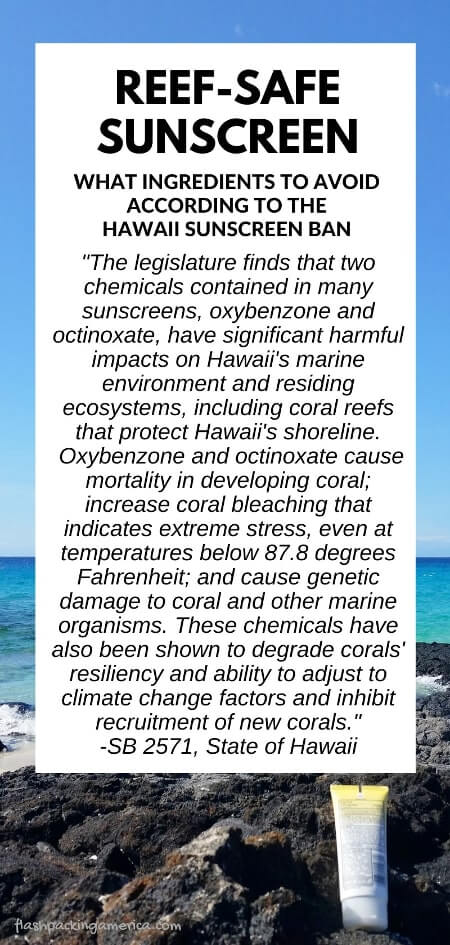
Read more on the official word about why the Hawaii sunscreen ban exists.
According to the Maui sunscreen ban, what is reef-safe sunscreen?
Maui is one of the Hawaiian islands. So the Hawaii sunscreen ban also applies to Maui.
But the County of Maui did not agree with the State of Hawaii’s definition of reef-safe sunscreen, and Maui has taken the Hawaii sunscreen ban one step further.
Maui has implemented their own Maui sunscreen ban.
Based on the Maui sunscreen ban, you can say that according to the County of Maui, the definition of reef-safe sunscreen is mineral sunscreen with zinc oxide or titanium dioxide as the active ingredients.
The Maui sunscreen ban is set to go into effect in October 2022.
Read more on the official word about why the Maui sunscreen ban exists.
According to the US Virgin Islands sunscreen ban, what is reef-safe sunscreen?
The US territory of the US Virgin Islands in the Caribbean has implemented their own US Virgin Islands sunscreen ban.
This includes the USVI islands of St. Thomas, St. John, and St. Croix.
Based on the US Virgins Islands sunscreen ban, you can say that according to the government of the US Virgin Islands, the definition of reef-safe sunscreen is sunscreen without the sunscreen ingredients of oxybenzone, octinoxate, and octocrylene.
According to the (attempted) Key West sunscreen ban in Florida, what is reef-safe sunscreen?
Key West in the Florida Keys attempted to implement their own Key West sunscreen ban.
Based on the wanted Key West sunscreen ban, you can say that according to the City of Key West, the definition of reef-safe sunscreen is sunscreen without the sunscreen ingredients of oxybenzone and octinoxate.
Key West city council voted YES to make the Key West sunscreen ban happen, but there was pushback from the Florida state government, and so it does not seem like a Key West sunscreen ban or greater Florida sunscreen ban will be implemented in the near future.
2. Aruba
According to the Aruba sunscreen ban, what is reef-safe sunscreen?
Aruba in the Caribbean has implemented their own Aruba sunscreen ban.
Based on the Aruba sunscreen ban, you can say that according to the country of Aruba, the definition of reef-safe sunscreen is sunscreen without the sunscreen ingredients of oxybenzone.
3. Bonaire
According to the Bonaire sunscreen ban, what is reef-safe sunscreen?
Bonaire in the Caribbean has implemented their own Bonaire sunscreen ban.
Based on the Aruba sunscreen ban, you can say that according to the country of Aruba, the definition of reef-safe sunscreen is sunscreen without the sunscreen ingredients of oxybenzone.
4. Thailand
According to the Thailand sunscreen ban, what is reef-safe sunscreen?
Thailand in Southeast Asia has implemented their own Thailand sunscreen ban.
This applies to national parks in Thailand, many of which are national marine parks that cover the ocean and are a snorkeling destination.
Although this Thailand sunscreen ban only applies to the national parks, consider making it reef-safe sunscreen in Thailand if you will be going to any of the beaches for the same reason you need reef-safe sunscreen in national parks!
Based on the Thailand sunscreen ban, you can say that according to the country of Thailand, the definition of reef-safe sunscreen is sunscreen without the sunscreen ingredients of oxybenzone (benzophenone-3, BP-3), octinoxate (ethylhexyl methoxycinnamate), 4-methylbenzylid camphor (4MBC), and butylparaben.
5. Palau
According to the Palau sunscreen ban, what is reef-safe sunscreen?
Palau in Micronesia of the Western Pacific has implemented their own Palau sunscreen ban (pdf).
Based on the Palau sunscreen ban, you can say that according to the country of Palau, the definition of reef-safe sunscreen is sunscreen with zinc oxide or titanium dioxide as the active ingredients.
It includes a specific ban on specific sunscreen ingredients: oxybenzone, octylmethoxycinnamate (EHMC), octocrylene (OC), 4-methyl-benzylidene camphor (4MBC), triclosan, methyl paraben, ethyl paraben, butyl paraben, benzyl paraben, phenoxythanol.
It is then noted that the ban on these sunscreen ingredients “essentially” leaves you to use sunscreen that contains zinc oxide or titanium dioxide as the active ingredients.
Side note!
Aside from sunscreen, also see more of what to pack for outdoor activities in Hawaii!
- The perfect type of shirt for swimming for snorkeling
- Do you need water shoes for snorkeling?
- Does a cheap waterproof phone case work for snorkeling?
- THE top things to pack for Hawaii
So then…
What’s the best sunscreen to buy when you want to protect the ocean environment while snorkeling or swimming?!
The quick list of reef-safe sunscreen, deemed reef-safe according some sunscreen bans:
- Sun Bum mineral sunscreen
- Neutrogena sheer zinc mineral sunscreen
- Aveeno positively mineral sensitive skin sunscreen
- Thinksport safe sunscreen
Ingredients for Sun Bum mineral sunscreen lotion SPF 50

See the current ingredients list directly from Sun Bum.
Read the reviews for Sun Bum reef-safe sunscreen.
Buy Sun Bum reef-safe sunscreen:
Ingredients for Neutrogena sheer zinc mineral sunscreen SPF 50

See the current ingredients list directly from Neutrogena.
Read the reviews for Neutrogena reef-safe sunscreen.
Buy Neutrogena reef-safe sunscreen:
Ingredients for Aveeno positively mineral sensitive skin sunscreen lotion SPF 50

See the current ingredients list straight from Aveeno.
Read the reviews for Aveeno reef-safe sunscreen.
Buy Aveeno reef-safe sunscreen:
- Popular Aveeno sunscreen lotion
- Popular Aveeno sunscreen face milk
- Popular Aveeno sunscreen lotion for kids
Ingredients for Thinksport safe sunscreen lotion SPF 50

See the current ingredients list directly from Thinksport.
Read the reviews for Thinksport sunscreen.
Buy Thinksport reef-safe sunscreen:
- Popular thinksport sunscreen lotion
- 2 pack of 3 oz lotion
- 2 pack of lotion + stick
- Popular thinksport sunscreen lotion for kids
And…
Check the sunscreen ingredients!

No matter which sunscreen brand you go for, if you’re looking to be at least somewhat reef-friendly, be sure to check the ingredients to confirm.
EVEN if it says it’s reef-safe.
EVEN if it’s a mineral sunscreen.
EVEN if it says it’s oxybenzone-free.
Some sunscreen brands may deem the sunscreen to be reef-safe or reef-friendly as long as it doesn’t contain oxybenzone.
But they still may have other ingredients deemed toxic according to some of the sunscreen bans.
It depends on how far you want to go to be reef-friendly!
So if you REALLY care to at least try to make your sunscreen safer for the ocean, you will want to be sure to look at the label of the ingredients of the sunscreen product that you actually have in your hand.
Also…
The way sunscreen is made can change!
So this is another reason why you’ll want to check to confirm the current sunscreen ingredients, and more specifically the ingredients of the actual sunscreen bottle that you plan to use.
The ingredients of sunscreen products can change.
The ingredients listed above are from checking in spring 2021.
And finally…
How can you make it so that you can wear LESS sunscreen?!

Wear swimming clothes!
The less skin you have exposed, the less sunscreen you have to wear!
You can cover up your skin more by wearing a swimming shirt or a rash guard.


So if you wear a swimming shirt, it means that you’ll be using far less sunscreen.
That means less sunscreen will be entering the ocean. It also means you have to be less concerned about having to reapply sunscreen too.
And if you take the word “sunscreen” literally, as in something that “screens” the sun, then actually, the BEST reef-safe sunscreen is a swimming shirt!
The less sunscreen YOU wear, the less sunscreen that gets into the ocean!

👆 As seen at a local beach in Hawaii: Please do not apply sunscreen before entering the water. Some locals in Hawaii are so serious about the impact of your sunscreen in the ocean that they go so far as to ask you not to wear sunscreen. Well, you can wear less sunscreen by wearing a swimming shirt!
It’s possible to find short sleeve swimming shirts and long sleeve swimming shirts that are made of material designed to protect against the sun’s UV rays.

See more: Finding a swimming shirt as your reef-safe “sunscreen”!
But even if you do wear a swimming shirt, you’ll still have exposed skin, so you will still want the traditional sunscreen for the rest of your body!
And that’s a bit about reef-safe sunscreen, according to the sunscreen bans!
HAPPY BEACH TIME WITH REEF-SAFE SUNSCREEN!
There are partner websites included in this post. I may earn a commission.